Mostrando entradas con la etiqueta CHECKED. Mostrar todas las entradas

martes, 18 de agosto de 2015

Hail Maus


This was the cover of "La segunda" a Chilean paper during the 70s under Pinochet's dictatorship. Perhaps you are asking yourself what has this to do with a literary blog. Well, I could not help myself of thinking about this particular header while I started reading Art Spiegelman's "Maus". A graphic novel which shows the plight which his father Vladek went through for being a Jew during the German Nazi invasion of Poland, however, the story does not deal exclusively with this topic but also with many aspects of his life. 


Since the very beginning of this graphic novel the author uses the own Nazi philosophy to criticize their doings. take a look to the epigraph of it.

“The Jews are undoubtedly a race, but they are not human.”

This cite, my dear fellow readers, was written by the very Adolph Hitler in his "Mein Kampf" a book that is considered by many the underpinning of the Nazi ideology, but why?


Chinua Achebe's full interview for CNN African voices.


To my mind, this is liken to what Chinua Achebe does on his writings. He said on an interview for CNN African voices "they were depicted as definitely not European, they were incapable of creating a civilization, of sustaining one"speaking about the stereotype that Europeans had towards African people. Furthermore, he started to use the language of the conquerors to deny this stereotype and probe that African culture was different but still very rich.


Coming back to Maus, I have to say that I am just a layman on the holocaust topic, and a think that really draw my attention was the fact that the own Jewish people acted as the Jew police who helped the Nazis to control and arrest their own fellows. When I read it, I immediately recall a discussion we had in class about "The Harlem Renaissance"  and the uncle Tom concept, which, surprisingly for me, is defined by Webster as:

1: a black who is overeager to win the approval of whites (as by obsequious behavior or uncritical acceptance of white values and goals)
2 :  a member of a low-status group who is overly subservient to or cooperative with authority.


Well, the Jewish police fits pretty well in that definition, but also does it the Chilean soldiers during the dictatorship because most, if not all, of the soldiers were young Chilean men who were part of the same people they were persecuting, whether voluntarily or forced by fear.


Regarding the writing style, I think Spiegelman being a cartoonist had the opportunity to, more or less, convey what his father felt when he survived the holocaust in the Nazi concentration camp. Doing a graphic novel with his father story was the bull-eye that made this work a Pulitzer winner, because language being an arbitrary system of sign cannot reliably depict reality, (do you remember our old pal Saussure signifier/signified). However, having the drawings and the testimony of an actual holocaust survivor helped him to go beyond from just words.
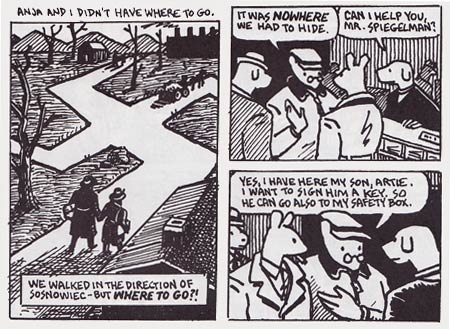


For example, take a look at  the left frame of this extract of the graphic novel, Vladek and his wife Anja had nowhere to go. they where being persecuted by Nazis and no one wanted to help them. The roads forming a swastika convey the meaning that wherever they would go, Nazis will be there,as well, to caught them. Also, I could feel his despair and hopelessness.


Furthermore, for me the allegory of using humans wearing animal masks (oops spoiler), Germans using cat masks and Jews using rat ones, besides Spiegelman keep on ironing the Nazi view of Jews,  is used to depict how naturalized the violence against them was seen since it is natural that the cat kill the mouse.


Finally, despite the fact that Jews went through the holocaust, I do not think that they learned a lesson out of it because what Israel is doing to Palestinian people nowadays is not too different from what the Nazis did to them.


Do you think that humanity after seeing a number of episodes like the holocaust will ever learn a lesson?

References:

-Art Spiegelman. (1986). Maus. New York: Pantheon books.


lunes, 17 de agosto de 2015

I can't even BEGIN to imagine

  
 In 1986 Art Spiegelman published “Maus”, a graphic novel that tells the story of his father during the Holocaust. He based the novel on his father’s memoirs, photographs and a personal research. But he, just as many of us, did not live all the brutalities that happened during the holocaust can we sympathize with such a living nightmare? Why did Art Spiegelman chose tell his father story?

   This story is about Art Spiegelman’s father, Vladek Spiegelman, who is a survivor of Auschwitz. It is narrated by his father’s own experiences. The way the story is told serves for the reader to understand that Art’s father is not a hero but someone who by chance and with the help of money, could survive the holocaust. Moreover, Art who is very attentive to his father story no matter interested is in the narrative he cannot fully comprehend the feelings and sensations that his father try to convey in his story.

   Sympathize with someone who has been through a tough situation is something that almost everyone had done in the past. Sometimes we don’t want to do it but it happens anyways, and in order to make that person who is suffering to feel better we come up with the famous words: “I know you must be feeling terrible” or something like that.

   What I mean  is that we can’t feel what someone else felt or is feeling since we are all different from each other, but we try to do it anyways en order to feel less guilty, as it is expressed in Maus II pag. 16 where Art confesses that “I know this is insane, but I somehow wish I had been in Auschwitz with my parents so I could really know what they lived through! I guess it’s some kind of guilt about having had an easier life than they did”.

   Yet Spiegelman in his comic does not try to appeal to our sensibility by glorifying is father just because he survived; on the opposite he attempts to express through the plot and later affrims in an interview that his father is a regular person with lots of defects and not because he had been through unimaginable suffering he is has become better person.(Spiegelman,2011)


   Then the second question remains: why did Spiegelman chose to tell his father story? Based on what I read from an interview made to Spiegelman and from the novel itself, his main objective was to make people, who did not lived during that time realize whether it is possible or not to comprehend for real what the holocaust meant and was for those who actually lived it. But I can honestly say that I can’t even begin to imagine what the holocaust survivors went through.   


Cooke, R.. (2011). Art Spiegelman. The Guardian,  17-08-2015, www.theguardian.com

The Working Class [angry] Hero

From the mind of John Osborne and straight into the judgement of society, a story has been told to amuse us all, as it srikes us with a harsh representation of reality. 

Years make no distinction. Ever since there has been power, some have been left behind. The unfortunate ones, those who rise from the ashes of their own suffering to continue their never-ending struggle to gain recognition, and be considered as equals among those who rule or are wealthier. They are what has been forgotten over and over again.  


Osborne's own vision of the inequity that surrounded him was indeed captured in his famous play Look Back in Anger. But, could it be that, probably, most of the playwrights of his era did not only reflect their feelings on a story that would (hopefully) reach the stage unleashing a catharsis, but also, that they might have intended to re-enact and go back to their anger every single time the play was reproduced?. Perhaps as a way to remind themselves of their own struggle and, somehow, gain power in their field. Anyway, isn't that what all artists yearn for? 


I remember listening to John Lennon's Working class hero when I was younger, and I could not truly understand what he meant with his lyrics. I had no notion of several issues of the real world, I had not even met a person who would sit beside me -a child- and tell me all about injustice. I guess they did not want me to be disappointed. And so, when I became aware of what Lennon meant, I unfortunately met the word frustration.  

         Working Class Hero - John Lennon 


In fact, this frustration is also what I could recognize while reading Osborne's play, and it is marvelously portrayed by his main character, Jimmy. The way in which he attacks the elite to the point in which his own wife becomes the slave of his awful words, clearly demonstrates the need of the author to put his frustrated thoughts out into the world in such a rush and with so much anger, that he leaves no room for a pause or a rewind (as I did with Lennon's record). The reader, or the expectator, feels an undeniable need for knowing when will Jimmy reach a limit. In spite of the alternative reasons that Jimmy may have, such as the death of his father when he was just a child, what shines brighter is his will to express his rage towards his social and financial conditions. Circumstances that turn him into this working class hero, resentful of the world. 


Then, I also recall Jimmy's routine on Sundays, and Lennon's words crash into the scene:

"Keep you doped with religion, and sex, and T.V
And you think you're so clever and classless and free
But you're still fucking peasants as far as I can see"

Somehow, those lyrics evoke the moments in which, while reading the papers and commenting on them, he believes Cliff and Alison are uneducated and ignorant. Although on the inside, he must feel the same, regardless of the amount of papers he may read all day.


Apparently, both Osborne and Lennon thought of their frustration in the same way, and they both also projected it on a masterpiece that would live on, so as to remind themselves and everyone else about the battles we all fight within. And, though Jimmy may not be considered a hero by the audience, he deserves the credit for being Osborne's spokesman, and therefore, his hero.


The Reality of Many

Long day’s journey into night it’s an autobiographic play written by Eugene O’Neill in 1941-1942 which by its name you cannot guess about what it is about. But one you read the play or watch the performance you realize in the very first lines or minutes that the play can be understood by anyone who belong to the human species. (Don Dale, 1999)(One may think the main thematic of such play is no longer attractive for the public. Yet its plot is so close related to the reality of many families nowadays that in my opinion this play is timeless)


Why? 
The play depicts the dynamics of a regular family composed by the father, the mother and their two children. But not a “regular” family such as the ones we watch in a TV-show or a sitcom where everybody can solve their problems right away and continue to be a happy smiley family. No, in this play all characters find themselves living in a regular family, more specifically O’Neill’s family; which like any family has lots of flaws and weaknesses.


And as many regular families one of their most recurrent flaw is that they are always trying to escape their problems. Take for example the fact that they are all the time blaming on each other and taking no responsibility for their mistakes, what’s more they do not even acknowledge such mistakes. A situation where this is clearly notorious is that through the whole play, the three men in the family continuously refuse to accept their mother’s morphine relapse, they blame each other.
 

For example Jamie blames Edmund for the mother’s relapse since he did not stayed with her. Although both of the brothers know what is really happening the do not admit or talk openly about their mother’s addiction.


While that is going on the mother, whose name is Mary, does not care about any of the situations that surround her, she is only interested in what she had in the past and does not had in the present. To do this she uses morphine, in this way she blocks the reality from her life; a recurrent metaphor of her situation is the fog concept and how she describes it:


 “It wasn't the fog I minded, Cathleen. I really love fog. [...] It hides you from the world and the world from you. You feel that everything has changed, and nothing is what it seemed to be. No one can find or touch you anymore.”

For her the fog and the morphine are one and the same since both keep the real world out of her life, she does this to avoid problems.

The beauty of this play is that it does not try to beautify reality. In our lives we make mistakes, we do not talk about them; pretend nothing has ever happened just like in the play. What's more, we can actually see ourselves potrayed inin some pats of the play. The only difference is that O’Neill’s autobiographic play is a lot more dramatic than our daily routine problems. 


References

Don Dale. (1999). Eugene O'Neill's "Long Day's Journey into Night" on PBS-TV's "Great Performances. 17-08-2015, de style weekly Sitio web: http://www.styleweekly.com/richmond/eugene-oneills-long-days-journey-into-night-on-pbs-tvs-great-performances/Content?oid=137690

O'Neill, E.. (1956). Long Day's Journey into Night(pp). USA

Preserving the customs means to live them thoroughly.

It is quite easy to see how important traditions are in the world of Chinua Achebe's notorious novel Things Fall Apart, which of course reflects the importance of customs and ceremonies in our lives as a society and as individuals.

In the novel, different ceremonies take place along the year in Umuofia and, as the book states, "A man's life from birth to death was a series of transition rites which brought him nearer and nearer to his ancestors". This is also a remark of the closeness there is between the people and those who preceded them, as well as of the commitment of the Igbo people with the traditions they inherited from their ancestors. 

Tradition for many Chileans
In that same sense we can turn to our modern world, and our own place in society as Chileans. For quite a big portion of the population, tradition means no more than cueca, vino, chicha, empanada and maybe fútbol, encompassed in what can be seen as a calendar that designates when to celebrate and what to do. In the Igbo culture, in contrast, most traditions and festivities are born from the daily lives of the Igbo people, the planting and harvesting seasons, the work that must be done to provide food to the families and the things that are learned from that hard work. Those are reasons to celebrate and we can see how, driven by their work, the Igbo really lived their culture, rather than adapt to what they are told to celebrate, most of the times, by other people (who this way are able to satisfy their own needs) and not by the people themselves so that they can enjoy being members of a nation and its culture.
Missionaries among natives.

This leads us to the almost complete and blatant lack of knowledge about our own customs, their origins and history, our national heroes and personalities, our artistic expressions and artists, led obviously by the influence of foreign novelty, in the same way that most of the Igbo were blinded by the "wonderful" Christian religion and converted when given the chance.


Yet still some did not convert to the Christianism and stayed where they thought they belonged. Among the Igbo there was a strong bond with their land, as well as with the elderly people, who were seen as a source of knowledge and wisdom. The oldest men spoke with the most wisdom. And we can see in the novel how strong is the bond between people, their families and the homelands of their progenitors. As a matter of fact, in the Igbo political system, the family is an important institution. As Nigerian historian Oyediji Oluwaseun Babatunde says, "the Family Group is one of the most recognized institutions in pre-colonial Igbo society as the basic unit of every political institution. It comprises people of the same family. Not only that, each family group was autonomously headed by the title holder called ‘OKPARA’. The Okpara controls the family and judges any family disputes. He performs ritual and ceremonial functions on behalf of the family" (Oyediji, 2014).

This strong connection with the family, umunna; the persistent sense of belonging to the land, and the importance of the hard work embody one key element in the setting of this novel: Tradition in community. The Igbo people were able to preserve their customs and integrate them to their lives rather than living as slaves for them and for their deities. That is one of the things that transports you to their time and helps you visualize the events that take place in Umuofia, the land of Okonkwo.

References

https://profseunoyediji.wordpress.com/2014/04/06/igbo-pre-colonial-political-system-in-nigeria/ 

Achebe, C.(1958) Things Fall Apart. 92.


domingo, 16 de agosto de 2015

An endless tragedy.


Long Day's Journey into Night, written by Eugene O`Neill, is at least for me a complete tragedy based on a family which is constantly struggling against a plethora of problems and situations. It is quite frustrating how the family cannot find the solutions for their problem, in fact, the more we read, the more complicated turn the situations, falling in a permanent cycle where this family cannot escape.


To begin with, the plot is focused on the Tyrone family, where problems and negative situations are always present. First of all we have James Tyrone who is the father of this family. The main problem with this character is that he is the kind of person who criticizes his family without helping the members of it, moreover, he is extremely stingy even when it comes about family, in fact, James is the main cause of his wife Mary. Mary, who is the mother in this family, suffers of a dangerous addiction related to morphine. Even when she has been in a treatment to overcome her situation, she cannot quit morphine. Mary is affected by the past in a lot of situations during the play, making her vulnerable and unable to overcome her problems, mostly the one which is about her younger son  Edmund, who has tuberculosis. Edmund, as said before the younger son of this family, has a very poor quality health and as a matter of fact Edmund is actually the creator of the play, or at least his representation since the character is very similar to him in a lot of ways. Edmund  has two brothers, James Jr. his older brother who is known for being alcoholic and his daughter Cathleen, who seems to be an amiable person.


This play is a representation of a family full of defects and problems, however, this fact is not the main point of this. At first, I thought that it was about a tragedy, where the protagonist sooner or later would overcome the problems and difficulties which they have been trough, nevertheless, the “bad news” seems to never meet an end. We can appreciate a family where problems are pointed out, but solutions do not appear to be suggested by any member of this family. We can see how the beautiful image of a healthy family present in the past turns into a chaotic family in the present. Every member of this family is trapped in their personal past,  carrying it to their present lives and making it a fake reality where they cannot escape, in fact, in my personal opinion this is the main reason why they cannot overcome the problems. The tragedy present here somehow shows how people can try to evade the reality telling each others pleasant lies about their condition where in reality all of the members are destroyed inside, and that is the main reason of the existance of the fog, yes, a fog which actually makes the member to be apart from the reality, apart of what really matters, making them to fall in a permanent lie. In this particular point something particular aroused my interest, if we are talking about a fog, it means that actually it is not an impossible barrier to overcome as a giant wall would be, and this is the interesting point here, because being trapped in a fog means that somehow they want to be trapped there, they know in the deep of their hearts that the reality is not what they tell each others, however, they trap themselves in this fog just no not face the real problems which are actually destroying the entire family.In addition, this play seems to be a autobiography of O`Neill, reflecting somehow, his life.


As a personal reflection, I strongly believe that every family has problems, however, the most important thought in our minds MUST be to face and overcome them, even when this play represents all the opposite. Also, it show us the fact that sometimes reality is to cruel to be accepted and faced,and due to that we choose to live in a permanent lie, that is why I think that somehow our minds are invited to realize about this reality and situations, making us to think about this endless tragedy and what would we do in a similar situation.


.From your Ghost World into a hurricane of fresh air.

"It's true that fresh air is good for the body, but what about the soul that grows in darkness..." Frank O'Hara, Ave Maria (full poem: Ave Maria)


Somehow, it is not just fresh air, but it is reality itself which nurtures the mind and soul of the youth, young people who struggle to define their personalities in a world that expects them to grow into fine adults.

Of course being a witness of society is not enough. It takes the courage to experience it. An experience that often overwhelmes these kids that are so afraid to face the fact that adolescence does not last forever that, almost as an act of rage against time and its changes, they put the worst of their fears into words that convey a message for society and even for themselves. 

In this Ghost World between the end of a teenager stage and the beginning of a life as an adult (an awkward space in time that we may also dare to define as a transition), Enid and Rebecca project their own fear and melancholy towards everything that surrounds them. They do not only fear to become responsible grown-ups, but they also fear to become what they consider the misery of the real world: pretentious people, lonely people, abusers, sex addicts, mentally disturbed men and women, liars, among others. And so they begin to label every single human being that they encounter, without knowing details of their private lives, in fact, their mere appearance gives them a reason to diminish their humanity, almost as an unconscious will to turn their fear into a hilarious joke.


They have tasted the fresh air; they are two girls who have decided to put themselves out in the real world, although they do not feel they fit in well, because the panic that invades them is so strong that making up stories about their milieu sounds so much better... and so they never really know reality at all, they are blinded. From the very first moment in which they judge (or misjudge) a stranger, they just create a story within another. That is, they only see in reality what they choose to see, so as to feed the anger they carry within.

It is not a matter of cruelty, but it is a shield, or a way to protect themselves from what they fear the most: to come out of their Ghost World, their comfort zone.

Aren't we all, adults or adolescents, afraid at some degree of giving up our comfort zone? Aren't we all somentimes making up excuses or projecting our fears with no certainty at all about the real conditions in which change may happen?.


Perhaps, Daniel Clowes did not only intend to show us a bit of every teenager's mind, but also what every human being may experience in a certain transition throughout their lives. However, the truth is that "hormones or not", a teenager's point of view might be the most crude and honest one.


Sources:

- Ghost World, Daniel Clowes. 1993-1997
-http://www.poetryfoundation.org/poem/171382 
- 

A Teenage World


Ghost World is a graphic novel written by Daniel Clowes and it shows the story of two girls who are best friends named Enid and Rebecca. The novel conveys several emotions, such as: denial, love, insecurity, pressure, among others and it´s also characterized by its dark humor and a bit of comedy,


 Both girls are graduating from High school and figuring out what´s next with their lives. During the story one character tries her best to be different from the rest and not to fall in the society standars,  in fact she tries to be unique (at least physically) by changing constantly her style. On the other hand, the other main character is quite the opposite, because she does the things that most of the girls do when they are teenagers, girl stuff.


While reading it there is an obvious relation between real life and the one that is shown in the novel, you are asking yourself why? Well... teenagers can be childish, superficial, immature, etc. And taking a gander at the story we can see that in the behavior of the characters. Also the language spoken in the novel is very similar to the one the one that teenagers use, that means words and concepts that young people understand.


A variety of themes are exposed in Ghost World, for instance, sexuality, future expectations, relationships, superficiality, love.

The novel was very successful due to the exposure of problems that teenagers have to cope with when graduating. In the sense that the vision they have regarding the future; go to collage or go to work?  stay at home or move out? Decisions, decisions and decisions...probably the hardest part of being a teenager.

In my opinion, the end of the story is the moment in which we can truly recognize and see how accurate is the dialogue of the characters in comparison to real life, how similar is the behaviour of teenagers, how well reflected is the confusion that teenagers have when planing their future.


Why Ghost World?...People leave this small town in the search of their future and new opportunities, therefore we can see that not so many things happen in this town.


There is a quote from the novel that  states : "God, it drives me crazy when I know exactly what I want and I can´t find it anywhere". For me, that is one of the most common issues of teenage people. They start a search to find what they believe is missing and in that search they can go through changes, living different situations and coping with new problems.


Growing up - Macklemore and Ryan Lewis featuring Ed Sheeran


A reality in a play

Long Day´s Journey into Night is an American drama written by the playwright Eugene O´Neill and is considered as the masterwork of his life. The play had great success and is usually on the short list of the American plays last century.


Eugene O`Neill

The plot centres on the story of the Tyrone´s family. It shows the events that surround this particular family, whose bonds are getting worse, due to issues with family members. The living room is the place in which the play takes place and it starts with the return of the mother, Mary, who´s back home after a treatment.


What I found interesting in this play is that every member of the family has its own issue, regarding a certain problem, addiction or desease, for example: James Tyrone (father), his conflict is related to being stingy over the years and the way he criticizes his children but never did a self-criticism. Mary (mother) deals with her own addiction to morphine and after having done a treatment for it she is still an addict. James Jr. (older son) has a reputation for being a womanizer, an alcoholic actor and for living a life full of mediocrity. Edmund (younger son) is in bad health, and later on diagnosed with tuberculosis. Cathleen (daughter) is a bit ignorant but a friendly and nice person.
Every member has its own reality and due to that, there is a lack of communication inside the family. Thus, fighting is very common in the Tyrone family, is their normal.


Another important fact is that O´Neill´s life was very similar to the one shown in Long Day´s Journey into Night, since his family had the same problems, such as: morphine addiction of the mother, the lack of interest in life of the older son who did not take life too serious and some others,


We can make an obvious relation here, because every family in real life has its own world, different from others and live with it. Some families can work on that and solve them, some do not. Also the "Hope" that Tyron put on his children is so realistic, considering parents always want their children to be better than them and when they see a son not caring for their interests the fun/problem begins.


Cristopher Plummer as James Tyrone


References

http://www.biography.com/people/eugene-oneill-9428728

http://www.eoneill.com/artifacts/reviews/ldj0_times.htm

Foggy Journey Into Night

Long Day's Journey Into Night is an American play written by Eugene O' Neill. The play is set in 1912 and it was performed for the very first time in 1956, when O'Neill was already dead.

The success of the play can be acknowledged to the possibility that many families see themselves reflected on Eugene's story. Most of families have one alcoholic or a drug addict as a member of their family and I could say that almost all the families of the world have situations and conflicts they have to afford day by day.

As we checked in class, this text written in the 40's has 2 main elements that coexist in the plot, addictions and appearance. Firstly, we have addictions, such as Mary's addition to morphine or her alcoholic husband. Secondly, the performing theme, as the characters act as if everything is fine and they pretend they are having a perfectly normal life and also they show and convinced the rest of the people of that fake situation. Thus, here I let you one link the trailer of the theatre version of the play.


 Some elements that called my attention while reading this play, were the use of symbolism and imagery. Those are a set of techniques that Eugene O'Neill appeals to in order to create the perfect interpretation of what he wants to transmit to the audience and also to intensify the emotions involved,  just as it is explained in the article Eugene O'Neill: A Critical Study.

To my mind this use of imagery and symbolism, also attempts to the interpretation of some metaphors within the play. One the most relevant for me, is the metaphor or symbolism that the fog represents. 

If we look for the definition on the dictionary the definition of fog, we'll find the following, "A thick cloud of tiny water droplets suspended in the atmosphere at or near the earth’s surface which obscure or restricts visibility (to a greater extent than mist; stincly, reducing visibility  to below 1 km)" (Oxford, Oxford Dictionaries 2015).

Bringing the previous definition to the play, we could say that the fog covers the reality of everyone in the family, is the perfect element, which hides the situations of each member of the family. It hides Mary's and Jamie's addictions, Jamie's issue with money and Edmund illness. 


Now, If we pay attention to the play, the fog is present since the beginning, which may be a clue that O'Neill gave us, in order to set the scenario of difficulty and hidden situation between the characters.

For example, here we have one meaningful quotation, “None of us can help the things life has done to us. They’re done before you realize it, and once they’re done they make you do other things until at last everything comes between you and what you’d like to be, and you’ve lost your true self forever.” (Long Day's Journey Into Night, Eugene O'Neill, 1956).

 The preceding quote, allow us to label this fog as a strong element and metaphor that forbid the characters of overcoming their situations, they seem to be locked in their current reality.

The second quote that called my attention was, " The fog was where I wanted to be. Halfway down the path you can’t see this house. You’d never know it was here. Or any of the other places down the avenue. I couldn’t see but a few feet ahead. I didn’t meet a soul. Everything looked and sounded unreal. Nothing was what it is. That’s what I wanted—to be alone with myself in another world where truth is untrue and life can hide from itself. " For me this is a magnificent proof of the importance of the appearances and the desire of this family of being unnoticed. It's much more easier to pretend you don't see other's people problems and also that they don't notice you. It's better to have foggy communication and relationship, to not really know the person next to you, instead of trying to fix the problem together.  

At the end of the play the fog was even thicker than in the beggining, which could mean they couldn't overcome their addictions and fixations. Their shelter, the fog, finally becomes their jail.  


References:
 - Eugene O'Neill: A Critical Study, http://www.eoneill.com/library/winther/X.htm
- Oxford, Oxford Dictionaries, 2015, http://www.oxforddictionaries.com/definition/english/fog
- Long Day's Journey Into Night, Eugene O'Neill, 1956.


sábado, 15 de agosto de 2015

Ghost World, a reflect of our living world.

First of all, I would like to give a personal opinion about this novel since I strongly believe that it gives an ace to the heart to what teenager world is. In general, being a teenager is one of the most difficult periods of our lives; our minds are full of doubts, problems and undim thoughts which affect people’s lives and actions. This novel reflects this reality through the characters that appear in it, showing us a fragment of what adolescence is.


Ghost World is a graphic novel written by Daniel Crowel where the main characters are two best friends, Rebecca Doppelmeyer and Enid Coleslaw. In this novel we can realize the new importance of the concept "appearance", where it seems to be that it plays a very important role here, maybe because this novel is after 1990, where this kind of problems and visions were starting to become more usual.


On the one hand Enid is a girl who is usually making fun of people’s life styles and appearances. Enid cannot stand people who follow the typical tendencies, she always tries to be different from other people and that is the main reason why she cares so much about changing her appearance or look, since somehow, she tries to tell to the world that she is in fact, different.


On the other hand, Rebecca seems to be a “normal girl” compared to Enid, in fact, in a plethora of situations Enid calls Rebecca`s attention for liking articles or magazines related to teenagers lives since she finds that those articles are the responsible of creating a standardized society. Nevertheless, even when Rebecca seems to be very different compared to Enid, she does share some opinions with her and they really care about each other.


These two girls are immersed in a plot where we can actually see how they involve themselves in a world for them, a world where they can criticize; make assumptions and judge people just by the way they look.
 Due to the different thoughts in their minds, they actually start to believe things about people without any kind of evidence, just because the appearance tells them that they may be a specific kind of person, being blinded in their own thoughts about the world and people.Nevertheless, maybe if we go deeper we can say that Enid in fact was making the same mistake that the people who she hates make, and that is the permanent search of belonging to something. She was always arguing that she could not stand that kind of people, however, what would it happened if other people started to follow her style and beliefs about the world?, would it be an unpleasant stereotypes just as the ones that the people that she hates had?. Maybe she was not angry about the people following those stereotypes, maybe she was angry because those people were following stereotipes in which she could not fit.


 In this privatized world, where appearances are the most important factor at the moment of judging someone, we can see the reality of our world, at least for me the most interesting factor was the necessity of belonging to a group in order to find the identity that most of the teenagers try to obtain. It is incredible that those prejudices and judgments which are purely based on the appearance are still present in our lives, making us think that perhaps we have a long way to go before telling ourselves that we have progressed as human beings.